Before we get to Letter to Steve, I just want to apologise for the 1-day delay to its publication, which was due to the post I really wanted to do last night about the visit to Powderham Castle, and Dawlish.
Having said that, here is Letter to Steve VIII:
Hi Steve,
Before I start on Letter VIII, I just want very quickly to pop back to Letter V, where I talked about Hollow Lanes (our Hollow Lanes are very different from Gilbert’s). Well, The Staff at Gilbert White’s house have started doing a fortnightly series of video podcasts. The Presenter of the podcast is Kimberly James, the Collections Manager at Gilbert White’s House.
The Podcasts are up to Episode 6, and I wanted to tell you about it, because in this episode, Kimberly leaves the office to go for a walk around Selborne, specifically to look for today’s examples of Hollow Lanes, and she definitely finds them.
I don’t know how close the tracks Kimberly shows us are to Gilbert’s Hollow Lanes, but they really did look authentic. The YouTube Channel currently has 302 subscribers. I’d love to see that grow. Here is the link: https://www.youtube.com/watch?v=fxdbxFVf-cQ
With me being on Letter 8 and the channel being on Letter 6, I did consider changing so that we would be in sync. But, actually, where I get ahead, it’s lovely to have the opportunity to have a look back.
Unlike a couple of the previous letters, as I was reading Letter VIII, I had a good thought about the direction of my next letter to you, and was eager to get a draft started, no procrastination this week!
Gilbert started his letter by talking about what he describes as “three considerable lakes.” One he focuses on, Bean’s Pond, he describes as being of interest to naturalists. I had a look at Google Maps to see if I could identify Bean’s Pond – nothing. On the National Library of Scotland (what a gem that is for old maps), I looked at maps from between 1876 and 1910. There were some lakes, but nothing labelled Bean’s Pond. Oh well, not to worry, but interesting to look back.
I imagine Bean’s Pond to be some lake heavily edged by reeds in the middle of the woods. It won’t be the same as the most well-known lakes here in Gosport – The Cockle Ponds.
The ponds have been here since the 1600’s, but Model Yachting really started in the 1890’s and after the First World War, they were significantly refurbished by men under the Unemployment Work Programme, giving them a concrete path around the edge.
The popularity of Model Yachting probably reached its head in the 1920’s & 1930’s when Gosport hosting international championships, where hundreds of people would turn up.
The ponds are much quieter today, but are still heavily used by modellers.
I went through a phase of early morning walks, which would always feature a walk around the lakes. There were regular people whom I would stop and have a chat with and sometimes throw or kick a ball for their dog. But it was what was going on in the ponds that really interested me.
I have mentioned the Canada Geese in previous letters. A few of them would usually congregate on the grassy bank, and the remainder would gently cruise about on the pond, occasionally dipping their head to grab a piece of weed. Always a lovely sight.
It has been a challenge to see how close I could get to the Egrets. One had its back to me and was focused on finding breakfast. I got to within about 5 yards before it realised I was there and took off in a long sweeping glide over the pond.
The raucous laughter of the Gulls always makes me smile. A fair few, 30 – 50, would gather and shout at each other.
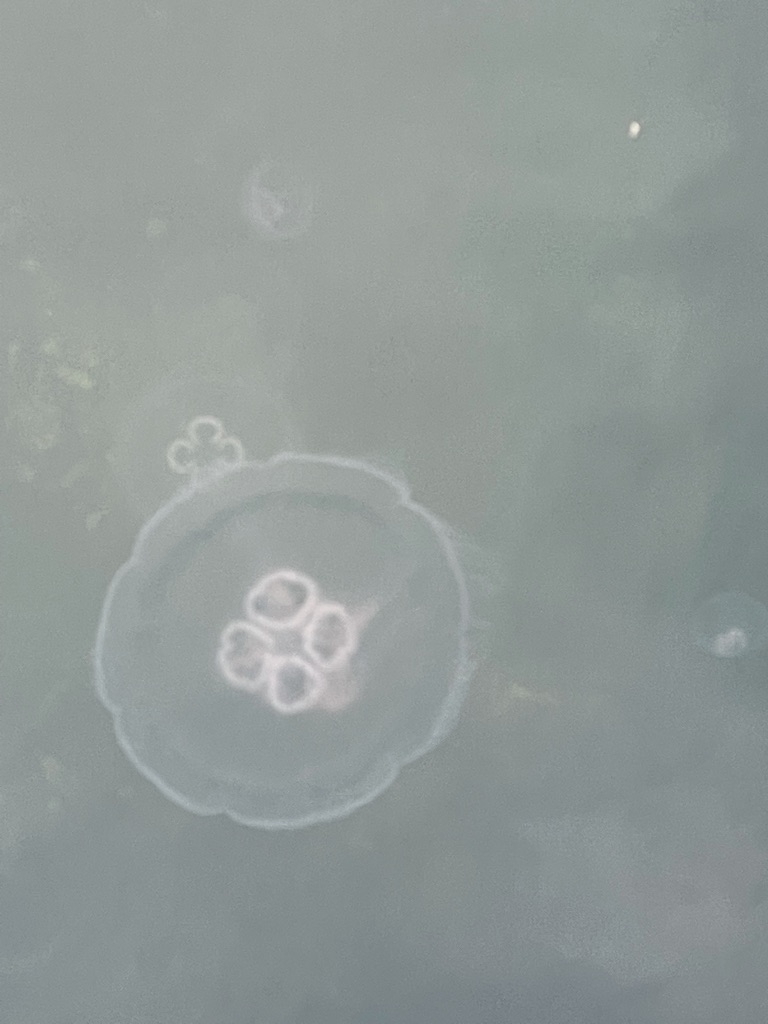
But my biggest favourites are the JellyFish. Moon jellyfish may be poisonous to something, but is it so mild that it doesn’t affect humans. You can tell that they are Moon Jellyfish (see the header picture), named after the three sets of glands that are visible across their back.
The area around the ponds and the shores of the harbour are both areas of Special Scientific Interest, and when you see them, you would understand why.
All The best
Bill
Back to Letter VII
Index to Letters to Steve
Forward to Letter IX


3 thoughts on “1963 – Letter to Steve VIII”