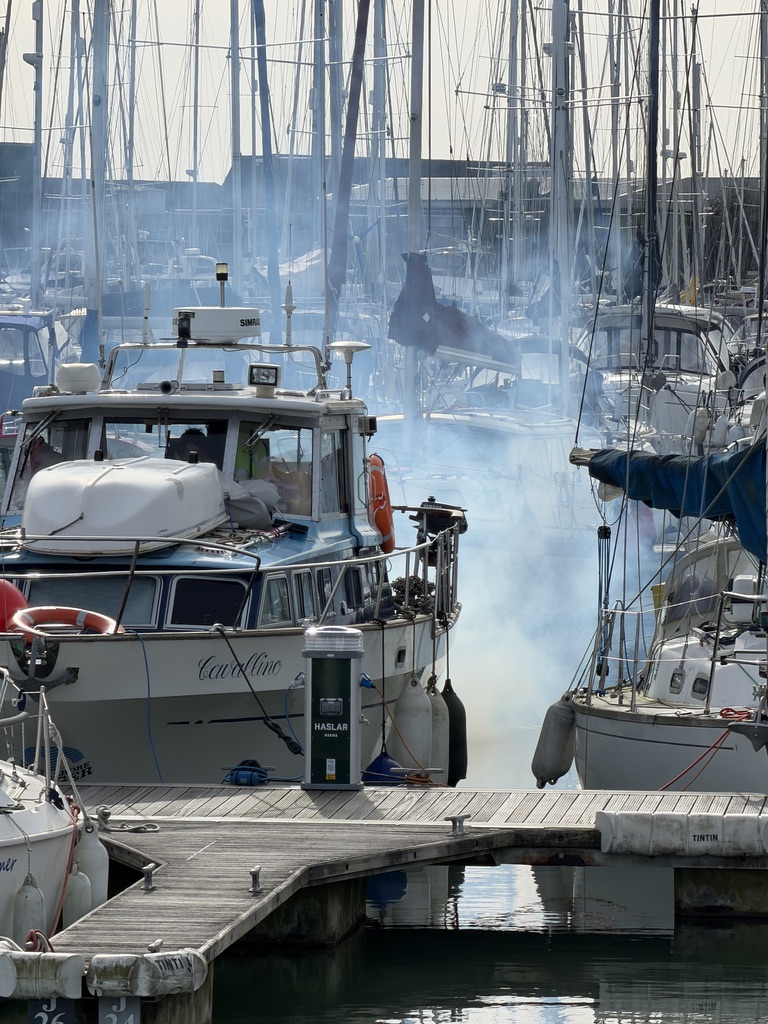
I saw this boat on Tuesday, it really was kicking out a lot of smoke.
I wrote on Tuesday about the Gilbert White letters, and have now read his Letter No. I, addressed to Thomas Pennant doesn’t have a date. So I googled to find that the letter was never posted and indeed was written later for the book”s publication.
Nonetheless, the letter is useful as it lays out the location and some of the geology around Selborne. It describes the layout of the village and really I suppose sets the scene for other letters.
Now, if I were to write something similar, it would I think be to my friend Steve, it woul.d be something like this;
Hi Steve,
I just wanted to write for you a quick letter to let you know about our new home town of Gosport. It sits on a penisula between Southampton Water and Portsmouth Harbour. The geology of the area offers a real mix and comprises, amongst others Alluvium, London Clay,, Brickearth and lots of gravel. It’s fairly low laying and boasts few hills althogh there are some dips around the Titchfield area that are quite extensive. Titchfield Haven, a wildlife area is well worth a visit with its regular collection of wildlife that is really quite extensive.
Some, like the birds asre mostly easy to see, and the haven provides hides that offer a good view of the living areas. Other wildlife may not be so easy to see, but with a little persistence, I’m sure you would be successful.
Stubbington and Lee-on-the-Solent are the two communities closest to Gosport itself, apart, obviously from Portsmouth just across the water.
Whilst the town of Gosport has really only been viable since the 16th Century, it has a deep, rich history that involves The English Civil War, the building of the Palmerston Forts (of which there are five that I know of along the peninsula (Gilkicker, Grange, Rowner, Brockhurst and Fareham) not all of them accessible to the public all of the time, but those that can be accessed are well worth a visit.
During the English Civil war the area that is now the Falklands Gardens were used to build a gun platform for the bombardment of Portsmouth.
The town itself. in its early days had ramparts built around for defence aginst mainly the French. These include the forts out in the Solent, but I’m not writing about those here. The Gosport Ramparts are mostly gone now, although some do remain, and these are now being actively preserved and in some cases restored.
The town carries a significant history from WW2, with particular note for Stokes Bay, where along the edge many of the modules of The Mulberry Harbour were constructed.
The town hosts three fine museum; The Explosion Museum, a story of Naval firepower, The Submarine Museum with HMS Alliance a surviving WW@ submarine that can be walked through with guides to assist.
Hosting Clarence Yard, one of Navy’s primary Victualling centres, where at its height in the 19th Century, 10,000 loaves of bread per day would have been produced for the ships in the harbour and Solent. Since its early days, Gosport has had significant links with the Navy.
I have to finish this letter now, to enable it to be published before the midnight deadline.
 Bills Posts
One thought on “1911 – Making Smoke”